


Overview
Oveview
The Canadian Wildlife Health Cooperative focuses on health surveillance and the assessment of health information to disseminate the knowledge needed to manage and maintain wildlife health in Canada. Since 2012, the CWHC has coordinated Canada’s national white-nose syndrome (WNS) response program. Over the years, to adapt to our understanding of all of the potential threats that Canadian bats are facing, the WNS program objectives have broadened from a single disease-focused, reactive approach to a proactive, bat health model. Our national bat health program uses a holistic approach to consider the interaction of biological, social, and environmental factors that may impact at-risk bat populations because bat health, like all wildlife health, is influenced by the cumulative effects of multiple stressors or threats. To accomplish the delivery of a comprehensive bat health program, the CWHC works in a collaborative partnership with a multi-disciplinary, inter-agency network of experts including researchers and decision makers.
The primary objective of the national bat health program is to promote healthy, resilient, diverse, and self-sustaining bat populations in Canada. Through the creation of a national bat action team with representation and expertise to direct the program, the CWHC will collaborate with key partners to develop and implement a national plan to manage bat health in Canada. The national plan will lay out strategic priorities central to understanding and managing bat health and organize a multi-disciplinary team dedicated to improving and ensuring the health of bats in Canada. Surveillance for early detection of emerging wildlife health issues remains an important activity for anticipating and responding to health issues, however, it is reactive and is just one aspect of a holistic bat health program. Using health information to protect and enhance resources critical for bats, anticipate and mitigate threats and risks to them, and minimize stress and mortality of bats contribute greatly to the health of individual bats as well as to bat populations as a whole. The CWHC will continue to provide ongoing health guidance to those with the responsibility for managing Canadian bat species and highlight opportunities for maintaining or improving the health of bat populations.
HOW CAN YOU HELP?
Keeping bats safe from harm and providing healthy roosting and feeding habitats is something that can be done by anyone.
Bats and people often live together harmoniously, although sometimes human-wildlife conflict occurs when bats repeatedly enter human-occupied living spaces. For information on bats in buildings, including how to promote healthy living spaces for people and bats, and create and maintain healthy foraging and roosting habitat, find guidance in our How to Manage Bats in Buildings documents.
Monitoring bats is not reserved for biologists only. Citizen scientists can participate in bat monitoring by conducting summer colony counts or learning how to get involved in acoustic monitoring programs. To learn about one such bat monitoring program, find our Guide for Bat Monitoring in Atlantic Canada under Population Monitoring resources. Also, public submission of bats found dead contributes greatly to our national bat health surveillance program. Visit our webpage to report and submit dead bats to the CWHC.
Disease prevention is essential to maintain healthy wildlife. The primary disease threat affecting many North American bats is the fungal disease white-nose syndrome. It is very important to prevent the accidental spread of the fungus that causes WNS by staying out of critical bat habitat, especially hibernation sites, including caves and mines. If it becomes necessary to enter these sites, it is essential to ensure that clothes and equipment are not contaminated prior to the visit and are properly decontaminated afterwards to prevent fungal spores from being unintentionally carried from one place to another. Please consult our decontamination protocol for more information.
In addition to avoiding the unintended direct human spread of the fungus that causes WNS, it is also important to prevent the accidental transportation of potentially infected bats from one place to another. If you are driving long distances make sure to check your recreational vehicle (RV) and transport trailer for stowaway bats. Bats like to roost in the umbrellas and awnings of RVs and can sometimes be found in the corners and crevices of trailers and cargo holds. Before departing for a new destination, have a quick look to ensure there are no bats roosting in or on your vehicle. The public is strongly advised not to touch any bats without the use of gloves. For more information, see our Bats Astray wildlife health note.
Keeping both bats and people safe is an important priority of the CWHC national bat health program. Understanding and managing the risks associated with human-wildlife conflict and communicating prevention strategies to the public helps avoid any harmful, unintended consequences that might be associated with interactions between bats and humans. The primary concern in these interactions is the possible transmission of bat rabies to humans. Read our fact sheets on Bats and Rabies to keep yourself, your pets, and the bats safe.
For more information, contact Jordi Segers, coordinator of the CWHC’s national bat health program and white-nose syndrome scientific program coordinator, by phone at 902-566-0744, or by email at jsegers@cwhc-rcsf.ca.
A National Plan to Coordinate the Management of Bat Health in Canada
The CWHC National Bat Health Report – 2024
WNS Reports & Maps
REPORTS
Select year:
Numbers correct as of September 24, 2025
SUMMARY BY PROVINCE 2025
| Province | Submitted | Tested | Positive 1 | Suspect 2 | Negative 3 | Pending |
|---|---|---|---|---|---|---|
| Alberta | 4 | 4 | 3 | 0 | 1 | 0 |
| British Columbia | 18 | 10 | 0 | 0 | 10 | 0 |
| Manitoba | 0 | 0 | 0 | 0 | 0 | 0 |
| New Brunswick | 5 | 0 | 0 | 0 | 0 | 5 |
| Newfoundland and Labrador | 5 | 0 | 0 | 0 | 0 | 5 |
| Northwest Territories | 0 | 0 | 0 | 0 | 0 | 0 |
| Nova Scotia | 0 | 0 | 0 | 0 | 0 | 0 |
| Nunavut | 0 | 0 | 0 | 0 | 0 | 0 |
| Ontario | 161 | 0 | 0 | 0 | 0 | 7 |
| Prince Edward Island | 16 | 0 | 0 | 0 | 0 | 16 |
| Québec | 21 | 1 | 1 | 0 | 0 | 2 |
| Saskatchewan | 101 | 8 | 0 | 0 | 8 | 48 |
| Yukon | 0 | 0 | 0 | 0 | 0 | 0 |
| TOTAL | 331 | 23 | 4 | 0 | 19 | 83 |
MAPS BACK TO TOP
(Click to see full sized image)
White-nose Syndrome Maps
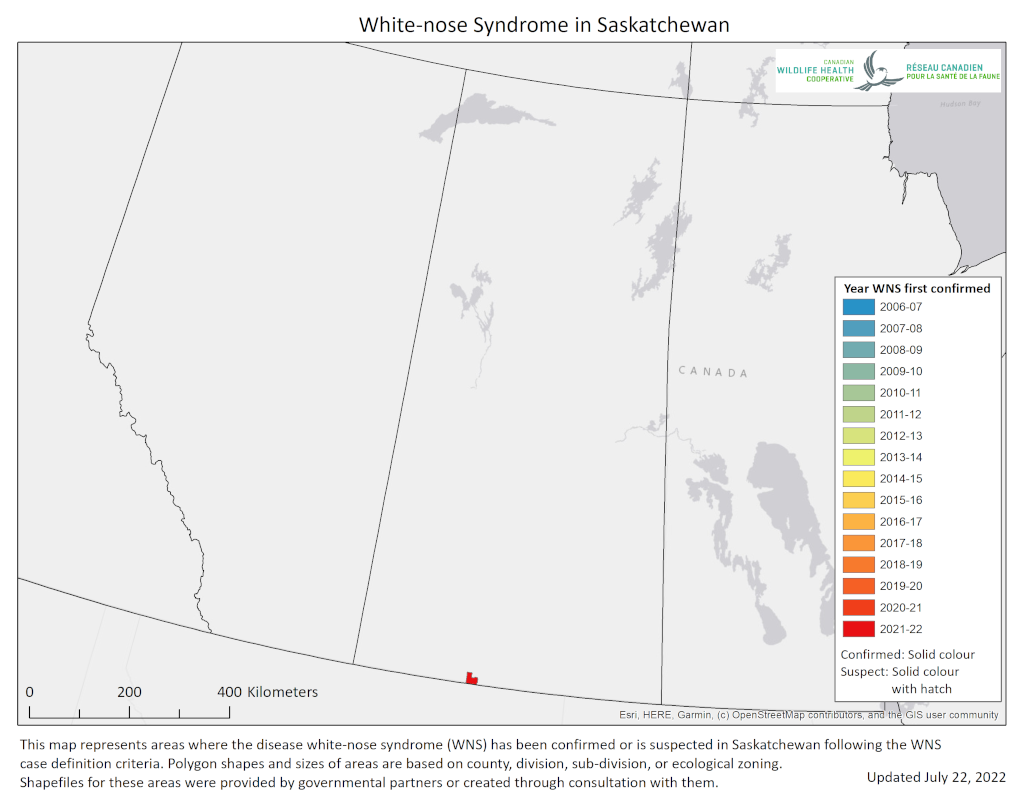
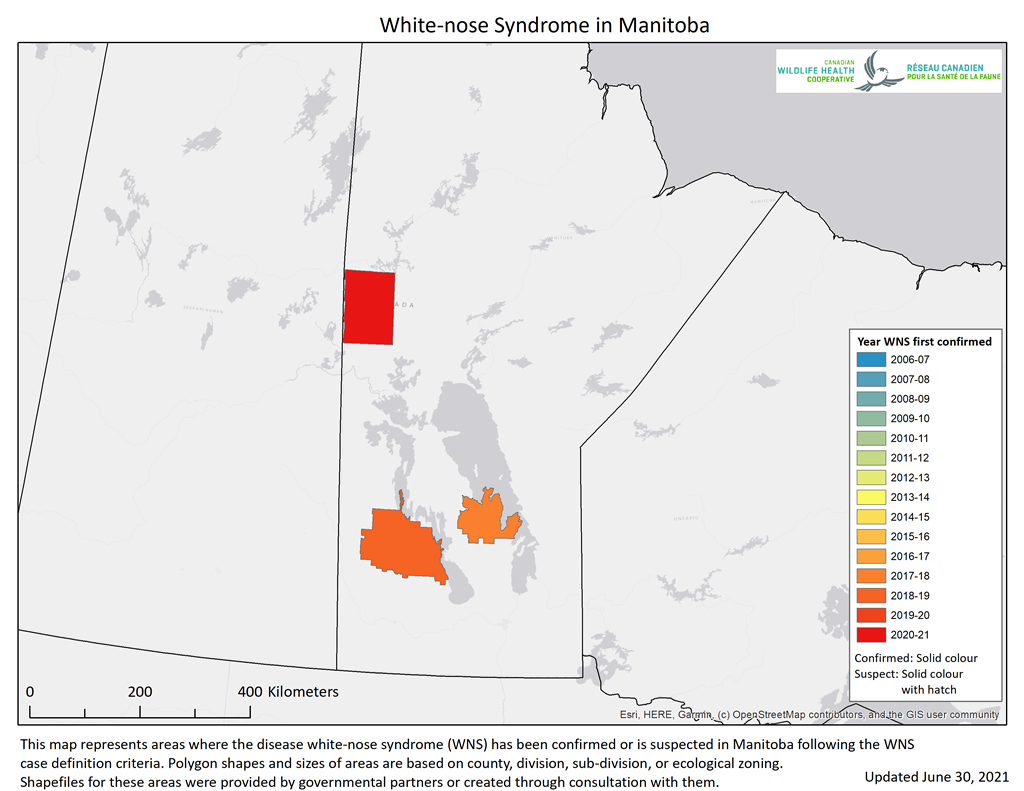
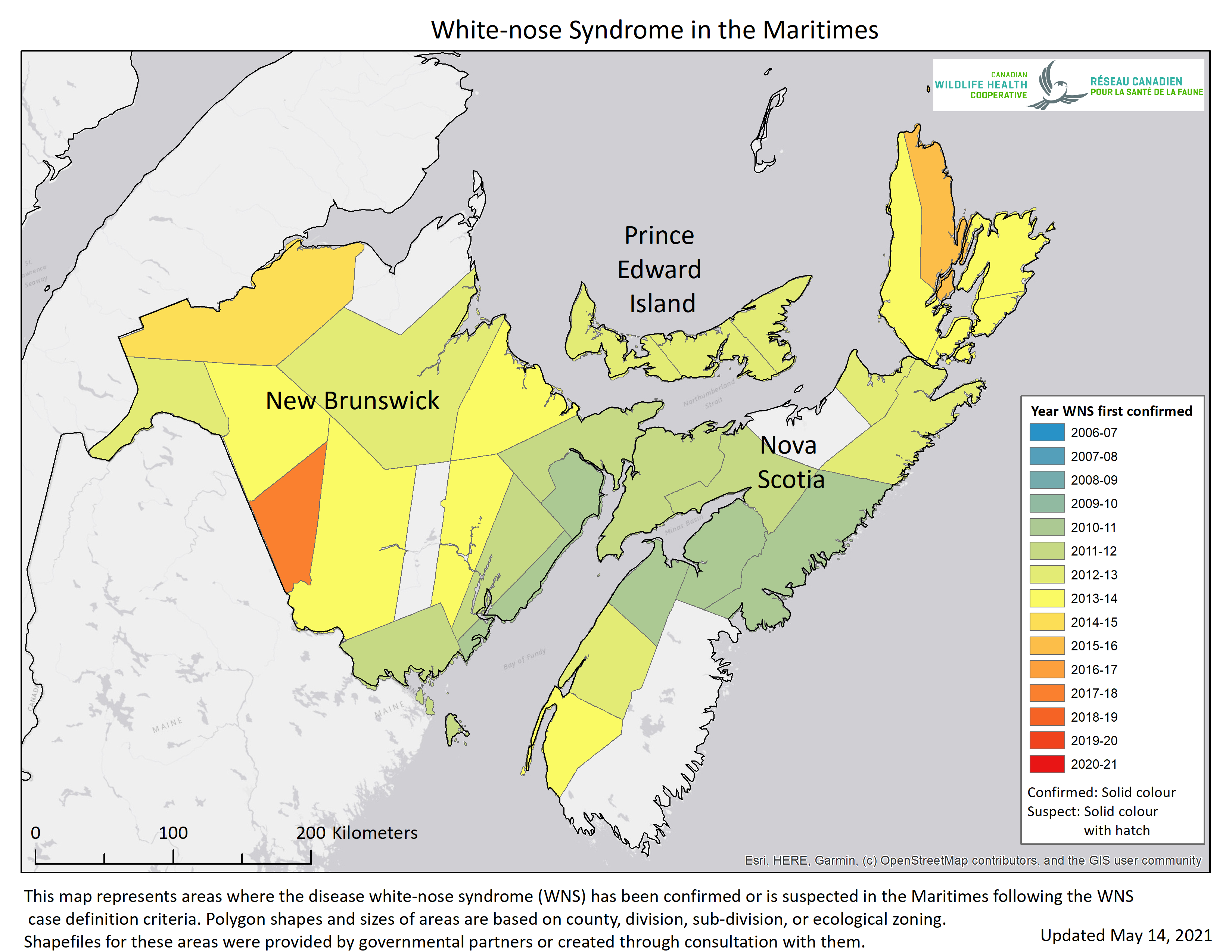
These maps represent areas where the disease white-nose syndrome (WNS) has been confirmed or is suspected in North America in accordance with the WNS case definition criteria. Polygon shapes and sizes of areas are based on county, division, sub-division, or ecological zoning. Shapefiles for these areas were provided by governmental partners or created through consultation with them.


Prairie

Central Canada


Atlantic

Pseudogymnoascus destructans Map
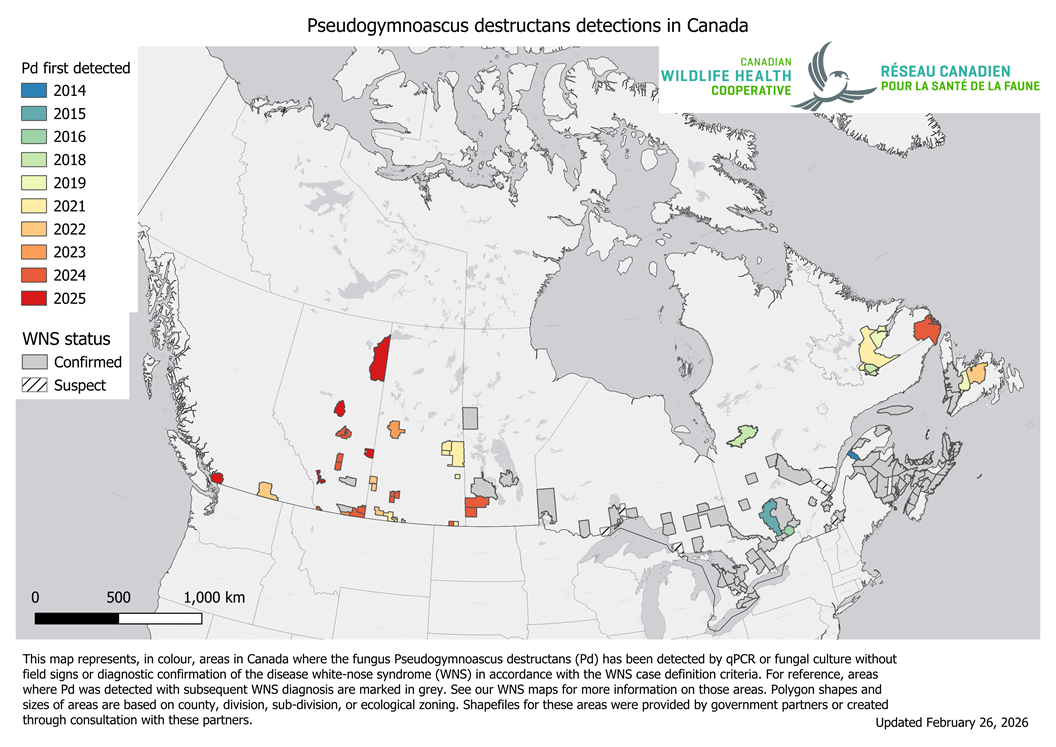
This map represents areas in Canada where the fungus Pseudogymnoascus destructans (Pd) has been detected by qPCR or fungal culture without field signs of or diagnostic support for the disease white-nose syndrome (WNS) in accordance with the WNS case definition criteria. Polygon shapes and sizes of areas are based on county, division, sub-division, or ecological zoning. Shapefiles for these areas were provided by governmental partners or created through consultation with them.
Diagnostic Criteria for Reporting Cases of Bat White-Nose Syndrome (WNS) at the individual specimen level BACK TO TOP
- Positive for WNS – Characteristic histologic lesions of WNS are present (Meteyer et al.) on an individual bat AND the bat is positive for Pseudogymnoascus destructans (Pd) either by Muller et al. qPCR or by fungal culture.
- Suspect for WNS – (one of the following criteria must be met)
- Characteristic histologic lesions of WNS are present on an individual bat but Pd is not detected, the test result for Pd is inconclusive (either by Muller et al. qPCR or by fungal culture), or further testing for Pd is not performed.
- One or more field signs* are observed in a bat colony AND Pd is detected (either by Muller et al. qPCR, fungal culture, or a tapelift performed directly on visible fungal growth on bat skin) on at least one individual of the same species AND histopathology is negative or is not performed.
- MULTIPLE field signs* are observed among species known to be susceptible to WNS and are within the currently recognized range of WNS but no samples are collected for diagnostic evaluation.
- Individual bats that are part of a confirmed WNS morbidity/mortality event are submitted to, but not tested by, a diagnostician. This criterion is for instances in which multiple samples from the same site are submitted, but only a subset of those samples is tested. The untested samples may be classified as suspect for WNS if the subset of tested samples is Positive for WNS and consists of the same species as the untested samples. Representatives of all species involved in the disease event should be tested.
- Negative for WNS – Characteristic histologic lesions are not present AND bat is negative for Pd (either by Muller et al. qPCR or fungal culture).
Diagnostic Criteria for Reporting the Detection of Pseudogymnoascus destructans (Pd) at the individual specimen level in the absence of field signs of WNS
- Pd Positive – Pd detected by Muller et al. qPCR or by fungal culture in accordance with laboratory-defined criteria in an environmental sample or on an individual bat with no other field signs of WNS* observed within the surveyed population. Bat carcasses submitted for diagnostic testing are placed in this category if Pd is detected on the carcass but there were no field signs of WNS observed on the individual AND histopathology is negative or is not performed. Repeat testing and/or independent secondary confirmation of Pd Positive results is warranted before this designation is applied to bat species of unknown susceptibility to WNS or areas outside the known geographic distribution of Pd.
- Inconclusive for Pd – Non-negative results by Muller et al. qPCR that are outside the range of accepted, standardized laboratory-defined criteria for Pd Positive. Results in this category may reflect the presence of minimal target DNA in the sample, representing a low-level Pd detection indicative of early infection. However, other possible explanations must be considered, such as contamination, non-specific amplification, or artifact from degradation of qPCR reaction components in the late stages of thermocycling. A designation of Inconclusive for Pd is made independent of other epidemiological evidence. Additional sampling and/or testing is warranted before broader inferences can be made about the presence of Pd at the survey site for official reporting purposes.
- Pd Negative – Pd is not detected (either by Muller et al. qPCR or fungal culture) in an environmental sample or on an individual bat. [Note: Although a negative qPCR or fungal culture result indicates that Pd was not detected in the tested sample, this does not guarantee the hibernaculum or bat colony from which the sample was collected is free of Pd. A lack of observed field signs* in the resident bat population is also not sufficient for assuming that a hibernaculum is Pd-free. Consistently negative results from a statistically robust sample size can, however, increase confidence that Pd is absent from the sampled population or environment.]
*Field Signs Associated with WNS in Bats
Winter/Spring – excessive or unexplained mortality at or near a hibernaculum; visible fungus on flight membranes, muzzle, or ears of live or fresh dead bats; abnormal behaviors including daytime activity, premature egression from the hibernaculum, or unexpected population shift to entrance of the hibernaculum; moderate to severe wing damage in nontorpid bats [Reichard et al.] or thin body condition (each considered a nonspecific field sign when observed by itself); yellow-orange fluorescent pattern of non-haired skin under UVA light [Turner et al.]
Summer/Fall – There are not consistent field signs associated with WNS during summer/fall.
Additional Comments
When screening for the presence of Pd, qPCR is preferred over fungal culture due to the greater sensitivity of the qPCR assay.
Results obtained using testing methodologies other than those referenced here will be considered preliminary and further testing with accepted standard methodologies is necessary for official reporting purposes.
For management purposes, hibernacula should be considered contaminated with Pd if they contain at least one sample (bat or environmental) that tests Pd Positive by the Muller et al. qPCR or fungal culture regardless of whether field signs of the disease were observed within the hibernaculum. A contaminated hibernaculum retains this designation indefinitely. The ability of Pd to persist long-term outside of hibernacula is not currently well understood.
Citations
Meteyer, C.U., E.L. Buckles, D.S. Blehert, A.C. Hicks, D.E. Green, V. Shearn-Bochsler, N.J. Thomas, A. Gargas, and M.J. Behr. 2009. Histopathologic crtieria to confirm white-nose syndrome in bats. Journal of Veterinary Diagnostic Investigation 21: 411-414.
Muller, L.K., J.M. Lorch, D.L. Lindner, M. O’Connor, A. Gargas, and D.S. Blehert. 2013. Bat white-nose syndrome: a real-time TaqMan polymerase chain reaction test targeting the intergenic spacer region of Geomyces destructans. Mycologia 105: 253-259.
Reichard, J.D. and T.H. Kunz. 2009. White-nose syndrome inflicts lasting injuries to the wings of little brown myotis (Myotis lucifugus). Acta Chriopterologica 11: 457-464.
Turner, G.G., C.U. Meteyer, H. Barton, J.F. Gumbs, D.M. Reeder, B. Overton, H. Bandouchova, T. Bartonička, N. Martínková, J. Pikula, J. Zukal, and D.S. Blehert. 2014. Non-lethal screening of bat-wing skin with the use of UV fluorescence to detect lesions indicative of white-nose syndrome. Journal of Wildlife Diseases 50: 566-573.
Resources
Regional Outlook
British Columbia
As of July 2020, there has not been a confirmed case of white-nose syndrome (WNS) in British Columbia. However, in the winter of 2015-2016, WNS was first detected in Washington State; the disease had made its way to the west side of North America, just south of British Columbia.
The British Columbia provincial government has asked that people help by reporting day-flying bats, sick or dead bats, or locations of summer or winter roosts, to the BC Community Bat Program at 1-855-922-2287 or info@bcbats.ca. To report your bat sightings, please visit the website of the Community Bat Programs of BC.
CWHC British Columbia works closely with the provincial government through the Animal Health Centre in Abbotsford. Through our diagnostic lab we help the province achieve their annual WNS surveillance and collaborate to provide additional bat health screening.
In addition to WNS preparedness, British Columbia and its community bat program are interested in understanding and mitigating other threats to bat health. British Columbia has identified five focal points for bat health management: coordination, risk reduction/mitigation, surveillance, population monitoring, and supporting research. Colony counts and North American Bat Monitoring Program (NABat) monitoring are conducted to gather baseline data on bat populations numbers and abundance across the province. Effects of agricultural pesticide use on bats is another focal point of bat research in British Columbia.
For more information about bats and WNS in British Columbia, please visit the provincial government’s WNS information page.
For WNS-specific enquiries, please contact:
Mandy Kellner
Ecosystem Biologist,
British Columbia Department of Forests, Lands and Natural Resource Operations
Contact Phone: TBC
Contact Email: mandy.kellner@gov.bc.ca
Purnima Govindarajulu
Small Mammal and Herpetofauna Specialist,
British Columbia Ministry of Environment and Climate Change Strategy
Contact Phone: 778-698-4426
Contact Email: purnima.govindarajulu@gov.bc.ca
ALBERTA
In 2022 the Wildlife Conservation Society Canada conducted surveillance for Pseudogymnoascus destructans (Pd, the fungus that can cause white-nose syndrome; WNS) at summer roosts in bridges throughout Alberta and detected Pd at a single roost in south central Alberta. In May 2024, the disease was found on 2 Little Brown Bats collected in southeastern Alberta. CWHC Alberta tests all submitted dead bats for WNS as part of passive surveillance activities at the University of Calgary-Faculty of Veterinary Medicine (UCVM).
Alberta Environment and Parks (AEP) (310-0000 [toll-free in Alberta]) is working with various partners to slow the spread of WNS by:
- Promoting proper decontamination protocol for cavers
- Closing public access to two large hibernacula
- Participating in the campaign to prevent “stow-away bats” (i.e., inform campers how to avoid accidentally transporting bats)
- Asking the public to submit bat carcasses between December-June
Alberta is trying to learn more about its bat populations and has been participating in the North American Bat Monitoring Program (NABat) for several years. This monitoring involves using bat detectors to record the echolocation calls of bats. NABat monitoring efforts increase every year in the province.
It is important to identify and conserve important bat habitat, particularly hibernacula and maternity colonies. Members of the caving community and the public play a big role in locating and protecting these sites. A key partner in reaching the public is the Alberta Community Bat Program (ACBP) (1-866-574-1706). This program delivers a number of important services:
- Operates a citizen science program to report and monitor maternity roosts
- Provides assistance to people with bat concerns or issues
- Delivers outreach and communication about bats
- Provides comprehensive information about Alberta’s bats including guidebooks:
Additionally, Alberta has been supporting research projects to learn more about the metabolism of bats at northern latitudes during hibernation, and investigating ways to prevent or minimise impacts of WNS.
For more information about bats and the disease in Alberta, please visit the provincial government’s WNS information page.
To report your bat colonies in the summer, please visit Neighbourhood Bat Watch.
If you are concerned about potential contact between a person and/or a domestic animal and a bat, please call the Rabies Hotline (1-844-427-6847).
For more information about WNS, to report day-flying, sick or dead bats, or to report locations of winter roosts, please contact:
Lisa Wilkinson
Species-at-risk Biologist,
Alberta Department of Environment
Contact Phone: 780-723-8556
Contact Email: lisa.wilkinson@gov.ab.ca
Western/Northern Region
CWHC Western/Northern collaborates with provincial and territorial agencies in Yukon, Northwest Territories, Saskatchewan, and Manitoba as well as with researchers from several academic institutions in these regions, focusing on bat rabies and other bat health studies.
Saskatchewan
In 2021 the Wildlife Conservation Society Canada conducted surveillance for Pseudogymnoascus destructans (Pd, the fungus that can cause white-nose syndrome) at summer roosts in bridges throughout Saskatchewan and detected Pd at these roosts in various eastern and southern regions of the province. In 2022 the first Saskatchewan case of WNS was confirmed by CWHC Western/Northern in a little brown myotis found dead in Grasslands National Park.
No bat hibernacula are known in the province, which makes WNS surveillance challenging and all the more reliant on reports from the public.
For more information about WNS, to report day-flying, sick or dead bats, or to report locations of winter roosts, please contact:
Iga Stasiak
Wildlife Health Specialist,
Saskatchewan Ministry of Environment
Contact Phone: 306-933-5406
Contact Email: iga.stasiak@gov.sk.ca
Erin Swerdfeger
Species at Risk Zoologist
Saskatchewan Ministry of Environment
Contact Phone: 306-539-8402
Contact Email: erin.swerdfeger@gov.sk.ca
MANITOBA
The first occurrence of white-nose syndrome (WNS) in bats in Manitoba was confirmed in the winter of 2017-2018 in the Lake St. George area. In 2018-2019 WNS was also detected in Riding Mountain National Park.
Little brown myotis and northern myotis are provincially listed and protected. Known hibernacula in ecological reserves and provincial parks are typically gated and permits are required to work with bats as is complete decontamination to minimize disturbance on bats and the risk of spreading WNS.
For more information about bats and WNS in Manitoba, please visit the provincial government’s WNS information page.
To report your bat colonies in the summer, please visit Neighbourhood Bat Watch.
For more information about WNS, to report day-flying, sick or dead bats, or to report locations of winter roosts, please contact:
Brian Joynt
Conservation Zoologist
Manitoba Wildlife Branch
Contact Email: Brian.Joynt@gov.mb.ca
YUKON
As of July 2020, there has not been a confirmed case of white-nose syndrome (WNS) in the Yukon. No hibernacula are known in Yukon and there are very few records of bats in winter, which makes WNS surveillance challenging. However, carcasses found outside of the winter season are submitted to the CWHC for bat health surveillance. Yukon Territory has a long history of collaborating and sharing data with partners from across Canada, including CWHC.
To report bat colonies in the summer, please visit Neighbourhood Bat Watch.
For more information about WNS, to report day-flying, sick or dead bats, or to report locations of winter roosts, please contact:
Tom Jung
Senior Biodiversity Wildlife Biologist,
Yukon Department of Environment
Contact Phone: 867-667-5766
Contact Email: Thomas.Jung@gov.yk.ca
NORTHWEST TERRITORIES
As of July 2020, there has not been a confirmed case of white-nose syndrome (WNS) in the Northwest Territories.
The Government of the Northwest Territories’ Department of Environment and Natural Resources (ENR) has been collaborating with regional partners to raise awareness about bats and WNS. Education and outreach campaigns have included school visits, bat box building, social media campaigns and the development of other communications materials related to bat conservation. ENR has also been working with the Conference of Management Authorities on the Management Plan for Bats in the NWT as required under the Species at Risk (NWT) Act. Additionally, bat surveys, population monitoring and WNS monitoring have been conducted by: ENR, other Management Authorities, Parks Canada, the Wildlife Conservation Society, the University of Calgary, and other partners.
For more information about bats and the disease in the Northwest Territories, please visit the territorial government’s WNS information page.
To report your bat sightings, please e-mail wildlifeobs@gov.nt.ca.
For more information about WNS, to report day-flying, sick or dead bats, or to report locations of summer or winter roosts, please contact:
Joanna Wilson
Wildlife Biologist (Species at Risk)
Northwest Territories Department of Environment and Natural Resources
Contact Phone: 867-767-9237 ext. 53214
Contact Email: Joanna_Wilson@gov.nt.ca
Ontario/Nunavut Region
CWHC Ontario/Nunavut covers both these regions and works collaboratively with the respective governments.
Ontario
The first occurrence of white-nose syndrome (WNS) in bats in Ontario was confirmed in the winter of 2009-2010 in the Bancroft-Minden area, about 200 km west of Ottawa.
CWHC Ontario/Nunavut is working with the Ontario Ministry of Natural Resources and Forestry (OMNRF) to monitor for the presence of WNS in bats. Selective routine diagnostic cases (based on species of bat, time of year, and location of the bat found) are tested for the presence of WNS. Additionally, the OMNRF submits swabs taken from bats suspected to be WNS positive to CWHC Ontario/Nunavut for testing.
Ontario prioritizes cases for WNS surveillance when it concerns a new species or a location where WNS has not been confirmed yet. Provincially, the biggest perceived threat to bats are impacts of wind farms, which impact both migratory and non-migratory (or short-distance migratory) bat species. Additionally, managing bats in buildings has an increasing priority.
For more information about bats and WNS in Ontario, please visit the provincial government’s WNS information page.
To report your bat colonies in the summer, please visit Neighbourhood Bat Watch.
For more information about WNS, to report day-flying, sick or dead bats, or to report locations of winter roosts, please contact:
Tamara Gomer
Wildlife Health Policy Advisor
Ontario Ministry of Natural Resources and Forestry
Contact Phone: 705-772-0642
Contact Email: tamara.gomer@ontario.ca
Nunavut
As of July 2020, there has not been a confirmed case of WNS in Nunavut.
Little is known about bats in Nunavut and bat sightings are rare or non-existent. There currently is no bat reporting tool or direct WNS contact for Nunavut, however, for more information about WNS, to report day-flying, sick or dead bats, or to report locations of summer or winter roosts, please contact:
Jordi Segers
National White Nose Syndrome Scientific Program Coordinator,
Canadian Wildlife Health Cooperative, National Office
Contact Phone: 902-566-0744
Contact Email: jsegers@cwhc-rcsf.ca
Québec
The first occurrence of white-nose syndrome (WNS) in the province of Québec was confirmed in March 2010 at the Caverne Laflèche in the Outaouais region and in additional caves in the Montérégie and Estrie regions. It is now considered widespread throughout most of the province.
The Ministère du Forêts, Faune et Parcs (MFFP) is very concerned about the consequences of WNS on bat populations. Since the discovery of WNS, the MFFP has been monitoring bat hibernacula to evaluate spring mortality and spread of disease. Population declines have been drastic in several hibernacula in the province that previously sheltered thousands of bats during the winter. Today, most hibernacula have considerably fewer bats than they used to. There are a few exceptions in the Outaouais region, where bat populations in caves appear to be gradually increasing. A guide for biosecurity measures and decontamination when visiting caves or mines and additional communication tools have been developed to help slow the spread of WNS and increase public awareness about this issue.
In 2014, the MFFP, in collaboration with other groups, including the Québec Centre for Biodiversity Science (QCBS), launched a citizen science program called Neighbourhood Bat Watch. This program monitors bat maternity roosts and receives summer emergence count data to evaluate changes in population size. So far, more than 366 colonies have been registered in QC with a total of 490 emergence counts being conducted for more than 183 different colonies. Preliminary results seem to indicate that in regions most recently affected by WNS, bat numbers in summer roosts have drastically declined by 75% to 90%. Fortunately, in some areas that have been affected by WNS for a longer period of time, the populations of several colonies seem to have now stabilised. However, this stabilisation in numbers may be primarily due to an increase in big brown bat numbers in the province. An ongoing research project will soon provide a better analysis of the activity and demographic changes observed in maternity roosts in QC. Additional monitoring includes capturing and PIT tagging female bats in several maternity colonies in QC every summer to determine their activity budgets (how much time [i.e., energy] they spend doing different activities) and how many bats return to these colonies each year.
In more recent years, the MFFP launched a research project for bat box improvements using a passive heating system. The goal is to produce a bat box model that would be significantly warmer than classic designs. Results should soon be available.
If you are concerned about potential contact between a person and/or a domestic animal and a bat, please call QC Info-Health at 811.
For more information about bats and the disease in QC, please visit the provincial government’s WNS information page.
For comprehensive bat-related information and educational tools, or to report summer bat colonies, day-flying, sick, or dead bats, please visit Neighbourhood Bat Watch.
For more information about WNS, or to report locations of winter roosts, please contact:
Ariane Massé
Biologiste,
Québec Ministère de l'Environnement, de la Lutte contre les changements climatiques, de la Faune et des Parcs
Contact Phone: 418-627-8694 poste 707310
Contact Email: ariane.masse@environnement.gouv.qc.ca
Anouk Simard
Biologiste,
Québec Ministère de l'Environnement, de la Lutte contre les changements climatiques, de la Faune et des Parcs
Contact Phone: 418-627-8694 poste 707383
Contact Email: anouk.simard@environnement.gouv.qc.ca
Atlantic Region
CWHC Atlantic region collaborates with provincial partners in Newfoundland and Labrador, Nova Scotia, New Brunswick, and Prince Edward Island. Areas within Atlantic Canada are experiencing up to a 99% drop in their overwintering bat populations. The public is crucial in contributing to WNS-surveillance efforts within Canada and are asked to report any day-flying or dead bats that are found. Day-flying during the winter is considered to be an abnormal behavior exhibited by bats and may be indicative of the presence of an infected hibernaculum nearby.
In addition to WNS and bat health surveillance, CWHC Atlantic leads initiatives related to managing bats in buildings, operates a bat reporting hotline, is training governmental and non-governmental partners to develop the North American Bat Monitoring Program in all four provinces, and collaborates with researchers from various academic institutions.
New Brunswick
The first occurrence of white-nose syndrome (WNS) in bats in New Brunswick was confirmed in the winter of 2010-2011 in a cave in Albert County (near Moncton).
New Brunswick’s priorities in bat health management are managing bats in buildings, including providing guidance for nuisance wildlife control operators and home owners, as well as providing balanced rabies messaging to protect the public. Additionally, New Brunswick partners with CWHC Atlantic Region to build capacity for sustained NABat monitoring to be conducted by various non-governmental groups.
For more information about bats and WNS in New Brunswick, please visit the provincial government’s WNS information page.
For any bat-related questions, to report all bat sightings (including day-flying, sick or dead bats), or to report locations of summer or winter roosts, please contact the bat hotline for Atlantic Canada at: 1-833-434-BATS (2287).
For WNS-specific enquiries, please contact:
Mary Sabine
Species-at-Risk Biologist,
New Brunswick Department of Natural Resources
Contact Phone: 506-453-3826
Contact Email: Mary.Sabine@gnb.ca
Donald McAlpine
Department of Natural Science Head
New Brunswick Museum
Contact Phone: 506-643-2345
Contact Email: Donald.McAlpine@nbm-mnb.ca
Nova Scotia
The first occurrence of white-nose syndrome (WNS) in bats in Nova Scotia was confirmed in the winter of 2010-2011 when a day-flying bat near Brooklyn (Hants County) was diagnosed with the disease.
Nova Scotia’s priorities regarding bat health include managing bats in buildings and monitoring and protecting persisting summer bat colonies. WNS surveillance continues despite populations being decimated to understand recovery potential of affected species.
For more information about bats and the disease in Nova Scotia, please visit these pages developed by the provincial government and the Mersey Tobeatic Research Institute (MTRI).
To report your bat sightings, please visit the Nova Scotia Bat Conservation website or call the bat hotline for Atlantic Canada at: 1-833-434-BATS (2287).
For any bat-related questions, to report day-flying, sick or dead bats, or to report locations of summer or winter roosts, please contact the bat hotline for Atlantic Canada at: 1-833-434-BATS (2287).
For WNS-specific enquiries, please contact:
Sarah Spencer
Species-at-Risk Biologist,
Natural Resources and Renewables, Wildlife Division
Contact Phone: 902-541-0081
Contact Email: Sarah.Spencer@novascotia.ca
Prince Edward Island
The first occurrence of white-nose syndrome (WNS) in bats in Prince Edward Island was confirmed in the winter of 2012-2013 when a dead bat found in the Bonshaw area (west of Charlottetown) was diagnosed with the disease.
Prince Edward Island’s primary focus regarding bat health is in understanding hibernation behaviour and identifying hibernacula to apply protective measures. Additionally, protection of natural summer roosts, especially those used by the northern myotis, is a provincial priority.
CWHC Atlantic works closely with the Prince Edward Island National Park to help deliver their species at risk bat monitoring program including acoustic monitoring, identification and designation of critical habitat, and managing of bats in building assets.
For more information about bats and WNS in Prince Edward Island, please visit the provincial government’s WNS information page.
For any bat-related questions, to report all bat sightings (including day-flying, sick or dead bats), or to report locations of summer or winter roosts, please contact the bat hotline for Atlantic Canada at: 1-833-434-BATS (2287).
For WNS-specific enquiries, please contact:
Darrian Washinger
Atlantic Bat Conservation Project Technician,
Canadian Wildlife Health Cooperative, Atlantic Region
Contact Phone: 902-894-2845
Contact Email: dwashinger@cwhc-rcsf.ca
Newfoundland and Labrador
The first occurrence of white-nose syndrome (WNS) in bats in Newfoundland and Labrador was in the winter of 2016-2017 in the St. George's-Stephenville area of Newfoundland. As of July 2020, there has not been a confirmed case of WNS in Labrador.
Newfoundland and Labrador have conducted NABat monitoring for several years and is working with CWHC Atlantic to expand these efforts province-wide. Additionally, the CWHC Atlantic bat hotline helps Newfoundland and Labrador with their WNS surveillance as well as with managing bats in buildings and other human-bat related conflicts.
For more information about bats and the disease in NL, please visit the provincial government’s WNS information page.
For any bat-related questions, to report all bat sightings (including day-flying, sick or dead bats), or to report locations of summer or winter roosts, please contact the bat hotline for Atlantic Canada at: 1-833-434-BATS (2287).
For WNS-specific enquiries, please contact:
Jessica Humber
Ecosystem Management Ecologist,
Newfoundland and Labrador Department of Fisheries and Land Resources
Contact Phone: 709-637-2423
Contact Email: JessicaHumber@gov.nl.ca